

Retail POS data security is the layered set of technical controls, authentication methods, network safeguards, and compliance standards that protect payment and customer data at every point of sale interaction. For UK retailers and hospitality operators, a single breach can cost far more than the immediate financial loss. It erodes customer trust, triggers regulatory scrutiny, and disrupts daily operations. Attackers target POS terminals using malware, phishing, vendor access compromise, and RAM scrapers to steal payment card data at scale, making PCI DSS compliance and layered defence not optional extras but operational necessities.
How do retail POS data security measures protect against common threats?
The most effective retail POS data security measures work in combination, not in isolation. No single control stops every attack. What stops breaches is a stack of overlapping defences that force attackers to defeat multiple barriers simultaneously.
Network segmentation and access restriction
Segmenting POS networks and restricting internet access for POS terminals reduces the attack surface and prevents lateral movement by attackers. In practice, this means your POS terminals sit on a dedicated network segment, completely separate from your guest Wi-Fi, back-office systems, and any shared staff devices. If an attacker compromises one device, segmentation stops them from moving freely across your entire network.
Encryption and tokenisation
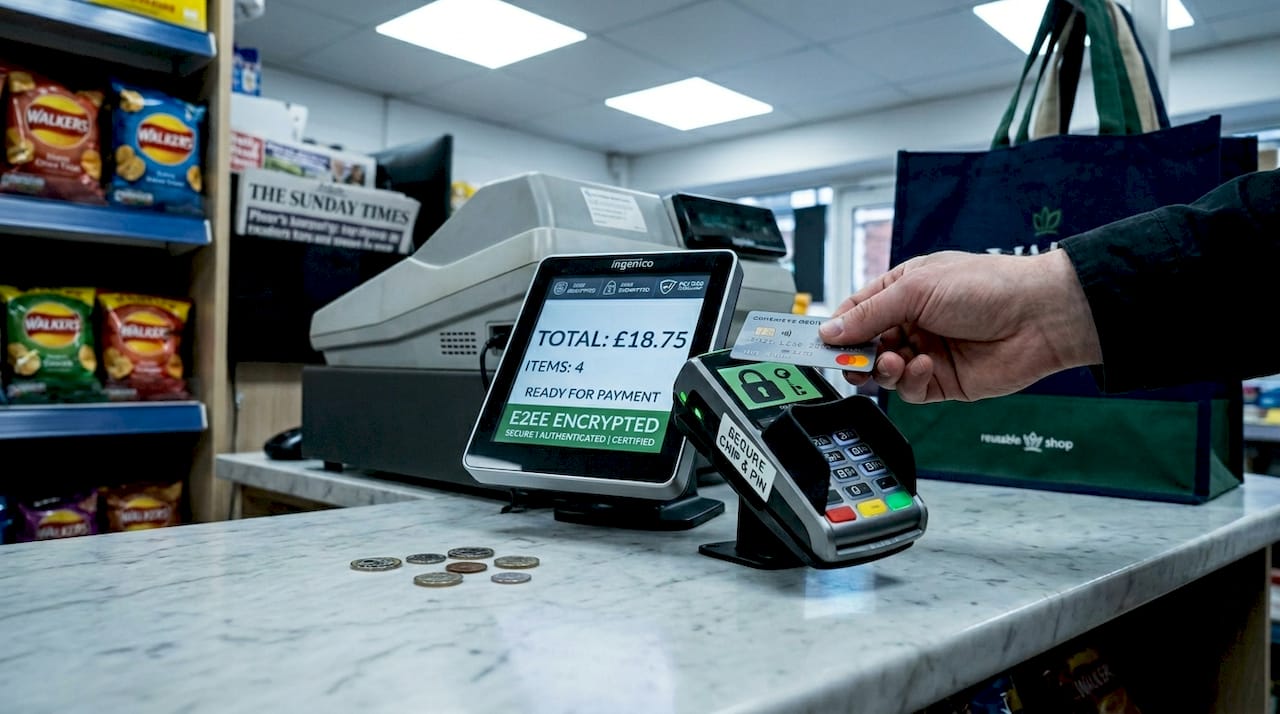
Encryption and tokenisation ensure card data never resides in readable form during processing or at rest, lowering risk even if systems are compromised. Tokenisation replaces sensitive card information with non-sensitive tokens that are only meaningful within the original payment system. This means even if an attacker extracts data from your POS terminal, what they retrieve is worthless outside your payment processor’s environment.
Multi-factor authentication and continuous monitoring
The following controls form the second line of defence against both external attackers and insider threats:
- Multi-factor authentication (MFA): Enforcing MFA for remote POS access ensures stolen credentials alone cannot grant access. This is particularly critical for vendor and administrator accounts.
- Least-privilege access: Staff should only access the functions their role requires. Removing inactive accounts and restricting admin rights limits the damage any single compromised account can cause.
- Continuous monitoring and logging: Retail security requires continuous monitoring with log analysis and real-time alerts to detect and respond to suspicious activity quickly. A centralised SIEM platform aids in correlating events and escalating threats before a breach escalates.
- Physical security: POS terminals should be physically secured to counters and inspected regularly for skimming devices or tampering. Staff training on recognising suspicious hardware is as important as any software control.
Pro Tip: Set up automated alerts for any login attempt outside normal trading hours. Most retail breaches begin with credential misuse during off-peak periods when monitoring is lightest.
What role does PCI DSS compliance play in securing retail POS data?
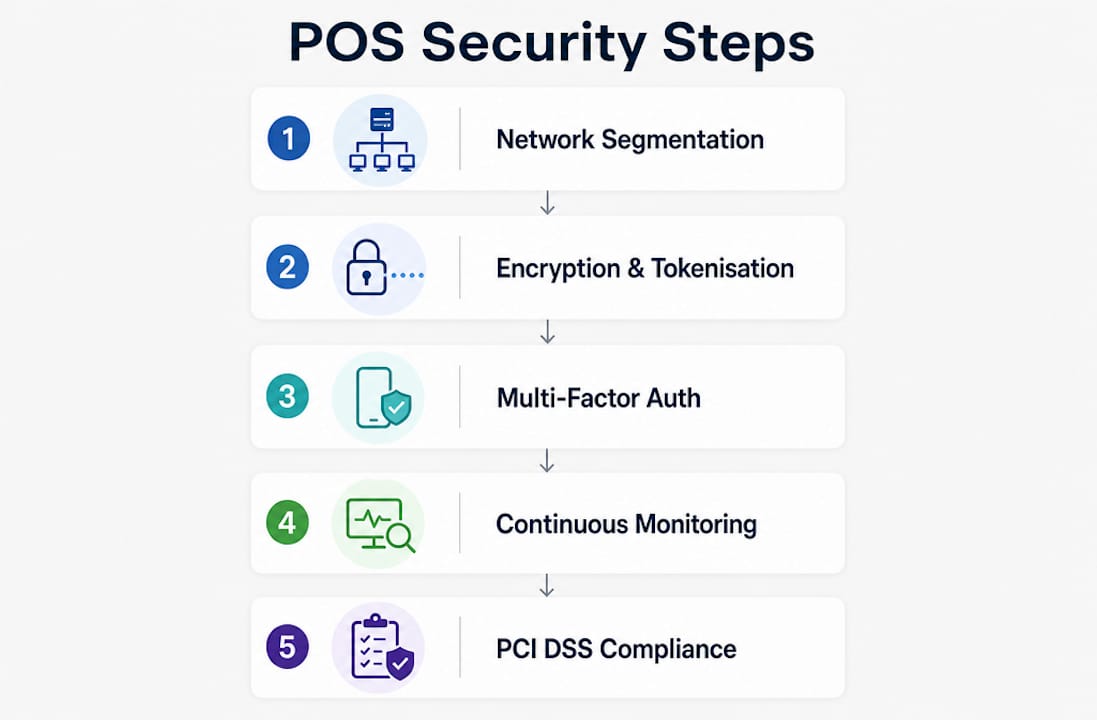
PCI DSS (Payment Card Industry Data Security Standard) is the baseline compliance framework every business that accepts card payments must meet. It defines six security goals and twelve requirements covering network controls, encryption, access management, monitoring, and regular testing. Understanding its scope is where most retailers go wrong.
What PCI DSS actually covers
PCI DSS mandates securing the Cardholder Data Environment (CDE) and all in-scope systems that store, process, or transmit cardholder data. The CDE is not just your POS terminals. It extends to any connected device sharing the same network segment, including monitoring infrastructure and management consoles. Retailers frequently underestimate this scope, leaving connected systems without required controls.
The table below summarises the six PCI DSS security goals and what they mean in a retail context:
| PCI DSS security goal | What it means for your retail operation |
|---|---|
| Build and maintain a secure network | Segment POS networks; use firewalls between POS and other systems |
| Protect cardholder data | Encrypt stored data; use tokenisation or P2PE for transmission |
| Maintain a vulnerability management programme | Patch systems regularly; use anti-malware on all in-scope devices |
| Implement strong access controls | Apply MFA, least privilege, and unique user IDs for all accounts |
| Monitor and test networks | Log all access; run vulnerability scans and penetration tests regularly |
| Maintain an information security policy | Document and enforce security policies across staff and vendors |
The compliance trap most retailers fall into
Omitting systems from CDE scope is a common failure that leaves those systems without required controls and monitoring. Passing an annual PCI DSS assessment does not mean you are secure for the other 364 days. PCI DSS v4.0 introduced continuous validation requirements precisely because annual snapshots miss the dynamic nature of retail environments. Compliance is the floor, not the ceiling.
Pro Tip: PCI DSS v4.0’s Customised Approach allows businesses to meet security objectives using modern methods like passwordless authentication via cryptographic credentials, with documented risk analysis. If your current authentication setup feels outdated, this pathway is worth exploring with a Qualified Security Assessor.
How can retailers implement practical POS security strategies?
Moving beyond compliance requires a structured approach. The following steps represent the practical best practices for retail point of sale data safety that go beyond ticking PCI DSS boxes.
-
Segment your POS network. Place all POS terminals on a dedicated VLAN with strict firewall rules. Restrict outbound internet access from POS devices to only the payment processor’s IP addresses. This single step eliminates a vast number of attack vectors.
-
Deploy PCI-validated P2PE. PCI SSC Point-to-Point Encryption (P2PE) encrypts card data at the point of interaction, keeping it unreadable until it reaches a secure decryption environment. Using a PCI-listed validated P2PE solution also reduces your PCI DSS scope, which simplifies your compliance burden.
-
Enforce MFA and remove shared credentials. Every user accessing a POS terminal or back-office system should have a unique account. Shared logins make it impossible to trace a breach to a specific individual. Enforce MFA for all remote access and administrator accounts without exception.
-
Control vendor and third-party access. Third-party vendor credentials are a significant source of breaches. Apply least privilege to all vendor accounts, monitor their sessions in real time, and revoke credentials immediately when a vendor relationship ends. Never allow persistent, always-on vendor access to your POS network.
-
Patch and scan regularly. Unpatched systems are the most common entry point for POS malware. Establish a monthly patching cycle for all in-scope systems and run quarterly vulnerability scans. For higher-risk environments, run scans monthly.
-
Train staff continuously. Phishing remains one of the most effective attack methods against retail businesses. Staff who can recognise a suspicious email or an unusual request for system access are a genuine security control. Run phishing simulations and update training at least twice a year.
You can find a structured approach to retail POS best practices that covers both operational efficiency and security checkpoints in one place.
What emerging threats should retail businesses watch in 2026?
The threat picture for retail POS environments has shifted significantly. Understanding where attacks are coming from now is the difference between a proactive defence and a reactive cleanup.
- Third-party compromise: 30% of retail breaches in 2024 involved third-party compromise, nearly double the previous year’s rate. Attackers increasingly target the vendors and integrators who have legitimate access to your systems, rather than attacking your perimeter directly.
- RAM-scraping malware: Despite encryption at rest, RAM scrapers extract card data from system memory during the brief window when data is decrypted for processing. Validated P2PE solutions close this window by keeping data encrypted through the entire transaction path.
- Web skimming: For retailers with e-commerce channels connected to the same back-office systems as their physical POS, web skimming scripts injected into checkout pages represent a growing risk that sits outside traditional POS security thinking.
- Ransomware targeting POS infrastructure: Attackers are increasingly encrypting POS back-office servers to extort retailers during peak trading periods, such as Christmas or bank holidays, when downtime costs are highest.
- Shared-device environments: Hospitality businesses in particular often share POS tablets between multiple staff members. Without individual user accounts and fast authentication methods, shared devices become a significant insider threat vector.
Combining segmentation, controlled outbound connectivity, and MFA reduces both direct data exfiltration paths and attacker lateral movement across retail networks. Small retailers benefit from aligning with a full risk-management framework like NIST CSF 2.0 rather than deploying isolated tools at the register alone.
Reviewing your retail POS infrastructure setup with security segmentation in mind is a practical starting point for addressing these vectors.
Key takeaways
Effective retail POS data security requires layered technical controls, PCI DSS compliance as a baseline, and continuous monitoring to stay ahead of evolving threats.
| Point | Details |
|---|---|
| Layered defence is non-negotiable | No single control stops breaches; combine segmentation, encryption, MFA, and monitoring. |
| PCI DSS is the floor, not the ceiling | Compliance covers the CDE baseline but does not replace continuous security improvement. |
| Vendor access is a primary risk | 30% of retail breaches in 2024 involved third-party compromise; control and monitor all vendor sessions. |
| P2PE reduces scope and exposure | Validated P2PE solutions encrypt data at the point of interaction, limiting PCI DSS scope. |
| Staff training is a security control | Phishing and insider threats require human defences, not just technical ones. |
The uncomfortable truth about POS security in retail
I have seen the same pattern repeat across retail and hospitality businesses of every size. The owner invests in a new POS system, the installer sets it up, and everyone assumes the security is handled. It rarely is. The hardware may be solid. The software may be reputable. But the network configuration, the vendor access controls, the authentication policies, these are almost always left at default settings or skipped entirely because they feel like IT problems rather than business problems.
The businesses that get breached are not usually running obviously outdated systems. They are running reasonably modern setups with one or two critical gaps. A shared admin password. A vendor account that was never revoked. A POS terminal sitting on the same network segment as the guest Wi-Fi. These are not exotic vulnerabilities. They are the predictable result of treating security as a one-time setup task rather than an ongoing operational discipline.
What I would tell any retail or hospitality operator is this: PCI DSS compliance gives you a map, but you have to actually walk the route every day. The businesses that avoid breaches are the ones where the owner understands enough to ask the right questions of their IT provider or POS supplier. You do not need to be a security expert. You need to know what questions to ask and refuse to accept vague answers.
— John
How Ycr supports secure and reliable POS operations

Ycr has supplied POS hardware and software to UK retailers and hospitality businesses for over three decades. The POS hardware range includes terminals from SAM4S and iMin, built for reliability in high-transaction environments where security and uptime are both critical. Software solutions including SAMTOUCH and EZEEPOS support individual user accounts and access controls, which are the foundation of any sound authentication policy. For businesses looking to upgrade their setup with security and compliance in mind, Ycr’s POS software options are designed specifically for the retail and hospitality sectors, with next-day delivery and same-day dispatch available across the UK.
FAQ
What is retail POS data security?
Retail POS data security is the combination of technical controls, network safeguards, encryption, authentication, and compliance standards that protect payment and customer data processed through point of sale systems. It covers hardware, software, networks, and staff policies.
What does PCI DSS require for retail POS systems?
PCI DSS requires retailers to secure the Cardholder Data Environment through network controls, encryption, MFA, access management, continuous monitoring, and regular vulnerability testing. The standard applies to all systems that store, process, or transmit cardholder data, not just the POS terminal itself.
How does P2PE help prevent POS data breaches?
PCI-validated P2PE encrypts card data at the point of interaction, keeping it unreadable until it reaches a secure decryption environment. This closes the window that RAM-scraping malware exploits and reduces the scope of PCI DSS compliance for the merchant.
Why are third-party vendors a major POS security risk?
Third-party vendor credentials were involved in 30% of retail breaches in 2024. Attackers compromise vendor accounts because they often carry elevated privileges and persistent access. Applying least privilege, monitoring vendor sessions, and revoking access promptly when relationships end are the primary controls.
What is the single most overlooked POS security measure?
Network segmentation is consistently the most overlooked control. Placing POS terminals on a dedicated network segment, separate from guest Wi-Fi and back-office systems, prevents attackers from moving laterally across your environment after an initial compromise.