

Retail analytics is defined as the practice of collecting, analysing, and applying data from retail operations to make better decisions across sales, inventory, pricing, and customer engagement. Every transaction your business processes, every item scanned at the till, and every loyalty card swipe generates data that can be turned into a commercial advantage. The four core categories recognised across the industry are descriptive, diagnostic, predictive, and prescriptive analytics. For retail and hospitality managers in the UK, understanding these categories is the difference between reacting to problems and preventing them altogether.
What is the retail analytics definition and why does it matter?
Retail analytics uses sales, customer, and inventory data drawn from sources including POS systems, CRM platforms, loyalty programmes, and ecommerce channels to improve pricing, demand forecasting, and customer experience. That breadth of data is what separates retail analytics from a simple sales report. A sales report tells you what you sold last Tuesday. Retail analytics tells you why Tuesday underperformed, what will happen next Tuesday, and what you should do about it before Tuesday arrives.
The discipline is also known in industry literature as retail data analysis or retail intelligence, and both terms describe the same core practice. Knowing the retail analytics definition is not an academic exercise. It is the foundation for every investment decision you make in technology, staffing, and stock.

What are the core types of retail analytics and how do they differ?
The four core levels of retail analytics progress logically from understanding the past to shaping the future. Each type builds on the previous one, and skipping a level is a common mistake that leaves managers with data they cannot act on.
-
Descriptive analytics answers the question “what happened?” It covers sales summaries, footfall counts, and basket size averages. This is the most widely used type and the starting point for any retail data analysis programme.
-
Diagnostic analytics answers “why did it happen?” It correlates variables, for example connecting a drop in café revenue to a change in opening hours or a competitor promotion nearby. Without this layer, you are left guessing at causes.
-
Predictive analytics answers “what will happen?” It uses machine learning and AI to forecast demand, predict customer churn, and model the impact of a price change before you make it. This is where retail analytics starts to generate a measurable return on investment.
-
Prescriptive analytics answers “what should we do?” It goes beyond prediction to recommend specific actions, such as adjusting a promotion, reordering a product line, or reallocating staff hours across a shift.
Pro Tip: Start with descriptive analytics to build data confidence across your team, then layer in diagnostic and predictive capabilities once your data sources are clean and connected. Jumping straight to AI-driven prescriptive tools without reliable underlying data produces unreliable recommendations.
How does retail analytics compare to traditional retail reporting?
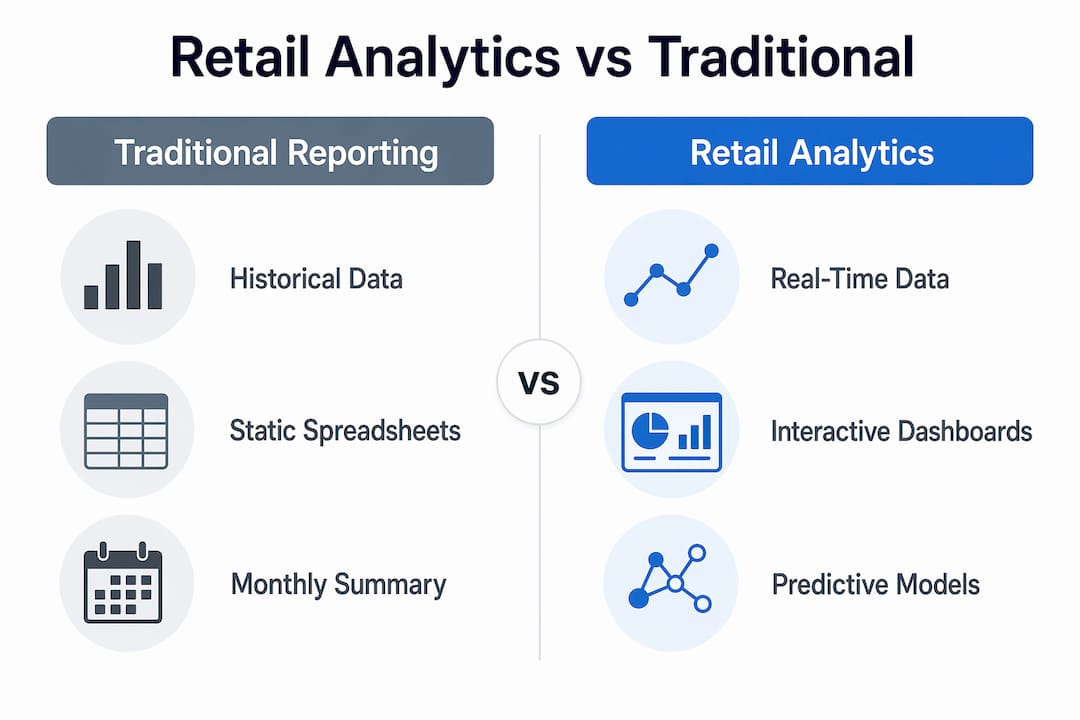
Traditional retail reporting focuses on historical summaries, typically weekly or monthly, presented as static spreadsheets or printed documents. Real-time data and AI techniques enable faster and smarter decision-making by connecting multiple data points in near real-time. That shift from static to live is the most commercially significant change in retail operations over the past decade.
The table below summarises the key differences between the two approaches.
| Feature | Traditional reporting | Retail analytics |
|---|---|---|
| Data timing | Historical, weekly or monthly | Near real-time or live |
| Data sources | Single source, usually till reports | POS, CRM, ecommerce, loyalty, social |
| Decision type | Reactive | Proactive and predictive |
| Output | Static summary | Actionable insight with recommended steps |
| Technology required | Spreadsheets, basic BI tools | AI, machine learning, integrated platforms |
The practical implication is straightforward. A café manager using traditional reporting discovers that a product line underperformed at the end of the month. A manager using retail analytics receives an alert mid-week and adjusts the promotion before the loss compounds. The role of analytics in retail is precisely this: compressing the gap between data and decision.
Integrating multiple data sources is what makes this possible. When your POS data sits in isolation from your CRM and ecommerce platform, you cannot see the full customer picture. Connected data is the prerequisite for any meaningful retail analytics programme.
What practical benefits does retail analytics offer retail and hospitality businesses?
The benefits of retail analytics are most visible in four operational areas: pricing, inventory, customer engagement, and marketing effectiveness.
- Pricing optimisation. Predictive models identify price sensitivity by product category and customer segment, allowing you to adjust margins without losing volume.
- Inventory management. Demand forecasting reduces both overstock and stockouts, cutting waste in food-led businesses and improving cash flow in product retail.
- Personalised customer engagement. A Customer Intelligence Platform provides a 360-degree customer view by combining sales data with external data such as demographics and social media trends. This enables targeted promotions that convert rather than broadcast.
- Merchandising and store layout. Retail analytics enables segmentation and tracking of shopping habits, helping you tailor product assortments and store layouts to emerging customer trends.
- Waste reduction. For hospitality businesses including restaurants and cafés, demand forecasting directly reduces food waste, which is both a cost and a compliance issue in the UK.
The reason to invest in retail analytics is not abstract. It is the difference between a business that responds to what customers did and one that anticipates what customers will do. For independent retailers and hospitality operators competing against national chains, that anticipation is a genuine competitive advantage.
Pro Tip: If you run a café or restaurant, apply predictive analytics to your top ten selling items first. Accurate demand forecasting on your highest-volume lines produces the fastest measurable reduction in waste and the clearest ROI to justify broader investment.
What is the role of POS analytics in retail and why invest in it?
POS analytics is the subset of retail analytics that draws specifically on point of sale transaction data to optimise checkout processes, inventory control, and promotional performance. POS system data is foundational for retail analytics applications in both retail and hospitality, because the till is where every customer interaction is recorded in a structured, consistent format.
The role of POS analytics in retail extends well beyond knowing what sold. Modern POS platforms capture transaction speed, payment method, operator performance, promotional redemption rates, and product-level margin data in real time. For a café operator, this means knowing which barista upsells most effectively and at what time of day. For a convenience retailer, it means knowing which promotional bundle drives the highest basket value on a Friday afternoon.
Investing in POS analytics also addresses security. Anomaly detection within POS data identifies unusual transaction patterns, such as repeated voids, excessive discounts, or off-hours activity, that may indicate fraud or staff error. This is a dimension of POS investment that many managers overlook until it becomes a costly problem.
The POS trends shaping 2026 include AI-assisted upselling prompts at the point of sale, integration between POS and loyalty platforms, and cloud-based POS systems that feed analytics dashboards in real time. For hospitality businesses in particular, the role of POS analytics in cafés and restaurants is growing rapidly as operators look to reduce labour costs and improve table or counter throughput without sacrificing service quality.
Pro Tip: When evaluating POS software, ask specifically whether it exports transaction-level data to a third-party analytics platform or BI tool. Summary-level exports limit your analytical capability significantly. Transaction-level data is what makes demand forecasting and customer segmentation possible.
Key takeaways
Retail analytics transforms raw transaction and customer data into decisions that improve margin, reduce waste, and build customer loyalty across retail and hospitality operations.
| Point | Details |
|---|---|
| Four analytics types | Descriptive, diagnostic, predictive, and prescriptive analytics each answer a different business question. |
| POS data is foundational | Transaction-level POS data is the primary input for accurate demand forecasting and customer segmentation. |
| Real-time beats static | Connected, live data sources outperform monthly reporting by compressing the gap between insight and action. |
| Activation is critical | Insights must be linked to operational tools such as inventory systems to produce continuous commercial impact. |
| Data harmonisation first | Integrating POS, CRM, and ecommerce data before deploying predictive models is non-negotiable for accuracy. |
Where most retail analytics programmes go wrong
The conversation in 2026 has moved on from whether to invest in retail analytics. The real question is whether you are activating the insights you already have. Most retail and hospitality businesses I encounter are sitting on months of POS data that has never been interrogated beyond a weekly sales total. That is not an analytics problem. It is an activation problem.
Activation means linking insights directly to operational platforms such as inventory systems and marketing automation, so that data drives decisions continuously rather than appearing in a quarterly review that nobody acts on. The businesses that get the most from analytics are not necessarily the ones with the most sophisticated tools. They are the ones that have connected their data to a specific decision, whether that is a reorder trigger, a promotional adjustment, or a staffing change.
The second mistake I see consistently is underestimating data harmonisation. Without integrating your POS, ecommerce, and CRM data into a single coherent view, your predictive models are working with incomplete information. The output looks credible but the recommendations are off. I have seen retailers make confident stock decisions based on POS data alone, only to discover that their ecommerce channel was cannibalising in-store sales in a way the model never accounted for.
My honest view is that the technology is no longer the barrier. Affordable, capable POS platforms and analytics tools exist at every price point. The barrier is discipline: cleaning your data, connecting your systems, and committing to acting on what the data tells you rather than what you assumed before you looked.
— John
How Ycr helps you build the data foundation for retail analytics
Retail analytics is only as good as the data feeding it, and that data starts at the point of sale. Ycr supplies UK retail and hospitality businesses with the POS hardware and software needed to capture clean, transaction-level data from day one. From SAM4S and iMin terminals to SAMTOUCH and EZEEPOS software, every product in the Ycr range is selected for reliability and integration capability. Whether you are setting up a new café, expanding a convenience store, or upgrading an existing retail operation, the right POS software solution makes the difference between data you can analyse and data you cannot use. Explore the full range of POS hardware available with next-day delivery across the UK.
FAQ
What is the retail analytics definition in simple terms?
Retail analytics is the process of collecting data from retail operations and analysing it to make better decisions about pricing, stock, promotions, and customer experience. It covers four types: descriptive, diagnostic, predictive, and prescriptive.
How does POS analytics fit within retail analytics?
POS analytics uses transaction data captured at the point of sale to optimise checkout performance, inventory control, and promotional effectiveness. It is the primary data source for most retail analytics applications in both retail and hospitality settings.
Why should a small retail or hospitality business invest in retail analytics?
Retail analytics reduces waste, improves stock accuracy, and enables targeted promotions that increase basket size. Even small operators benefit because the cost of poor stock decisions and missed upsell opportunities compounds quickly over time.
What is the difference between descriptive and predictive retail analytics?
Descriptive analytics summarises what has already happened, such as last week’s sales by category. Predictive analytics uses historical data and machine learning to forecast what is likely to happen next, enabling proactive decisions rather than reactive ones.
What data sources does retail analytics use?
Retail analytics draws on multiple data sources including POS systems, CRM platforms, loyalty programmes, ecommerce channels, and external data such as demographics and local trends. Integrating these sources into a single view is what enables accurate predictive modelling.